Sunday, January 24, 2016

To Accompany, Serve, & Advocate: A visit with Pope Francis

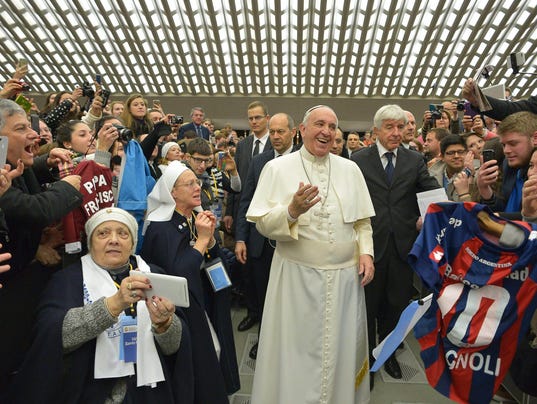
Photo from L'Osservatore Romano

Posted by: Jora Atienza

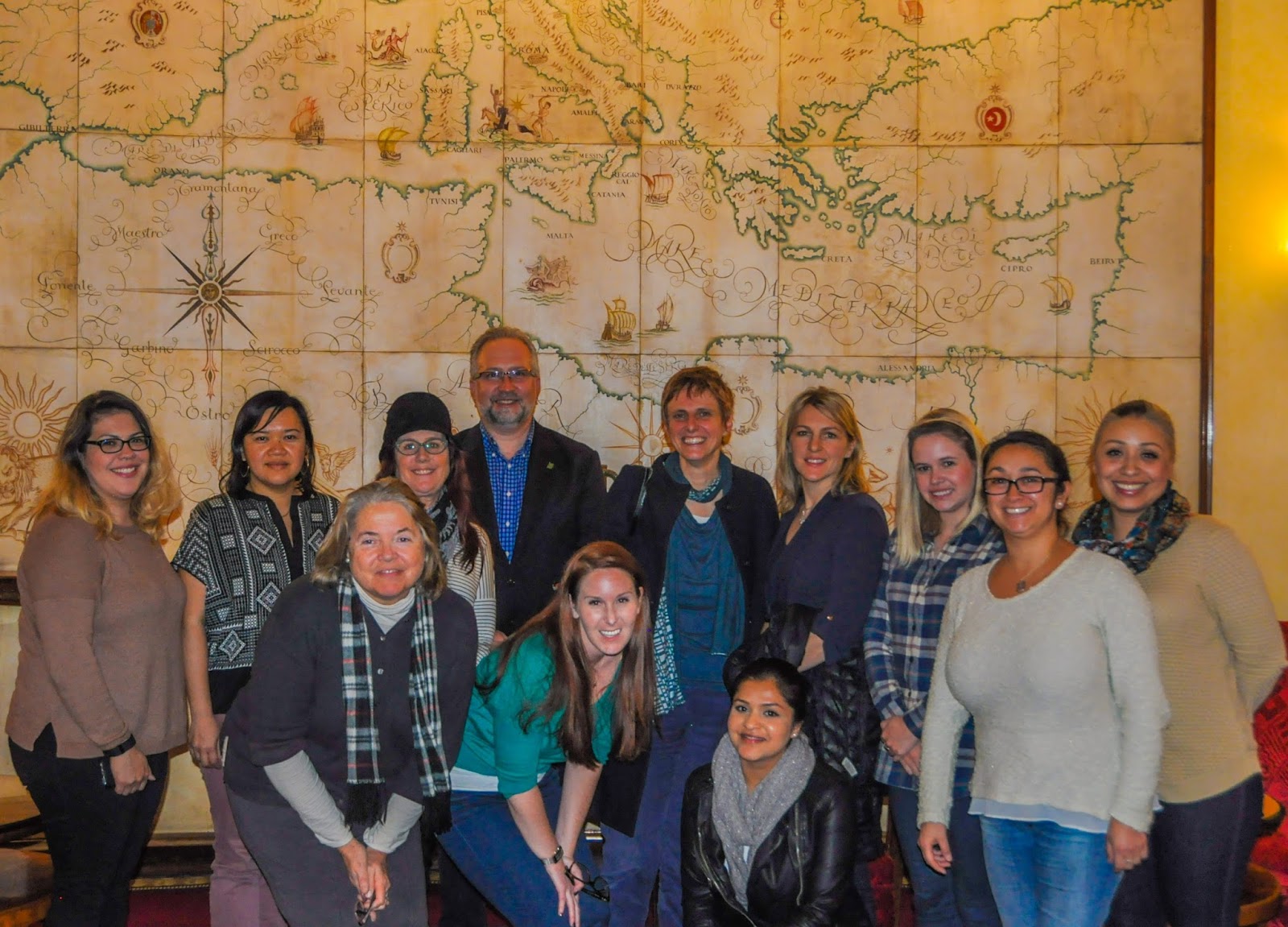
On Wednesday, January 13, Pope Francis held his first General Audience of the New Year, welcoming hundreds of pilgrims for an intimate address at the Vatican. This day included our group from USF, along with representatives from other universities, parishes, and other individuals from across the globe. His address was translated to multiple languages including Spanish, French, English, Portuguese and Arabic.  During his talk, Pope Francis spoke about the Jubilee Year of Mercy, a special time for Catholics around the world to “find the joy rediscovering and rendering… God’s mercy, with which [they] are all called to give comfort to every man and every woman.”  Thrilled by this opportunity, I joined a small group of USF students to get to the Vatican early; we also stayed until after the audience to be blessed and get a chance to meet Pope Francis.

As a Roman Catholic, I was profoundly moved by the Pope’s words about mercy, compassion, and love.  I was particularly struck by the following quote:

La parola “amore”, qui utilizzata, indica l’affetto, la grazia, la bontà. Non è l’amore da telenovela... È l’amore che fa il primo passo, che non dipende dai meriti umani ma da un’immensa gratuità.

The word love, used here, means love, grace, and goodness. It is not the love of the telenovela. It is love that takes the first step, that does not depend on human merit but by an immense generosity.

This idea of generous, active love connected with speakers that had met with our group in the days leading up to the Papal Audience.  Representatives from Jesuit Refugee Service International and Centro Astalli Foundation had all spoken about the core values of their work of accompanying, serving and advocating for refugees, asylum seekers, and other displaced people around the world. The idea of accompaniment struck me in particular, as each of our classroom speakers spoke extensively about being present and building deep connections with refugees and other displaced people.  That it is each person’s right to have his or her human dignity acknowledged in a meaningful way. 

As I watched Pope Francis – a Jesuit himself – greet the crowd that remained after his address, I marveled and was moved at how he modeled this value of accompaniment.  He greeted dozens of people one by one, unhurried and present for each person, taking almost an hour to move out of the room.  I thought about the various stories I have read about the Pope visiting with those in need, whether incarcerated youth or his first Papal visit to Lampedusa, where he held mass for refugees, and felt that his vocal support of refugees and displaced peoples in Europe and around the world has helped pushed organizations and governments to respond to this crisis in a more substantial and meaningful way.

The Historian's Nightmare: "Those Who Cannot Remember the Past..."

Photos courtesy of englishhistoryauthors.blogspot.com and www.3quarksdaily.com

By Lauren Pinsker

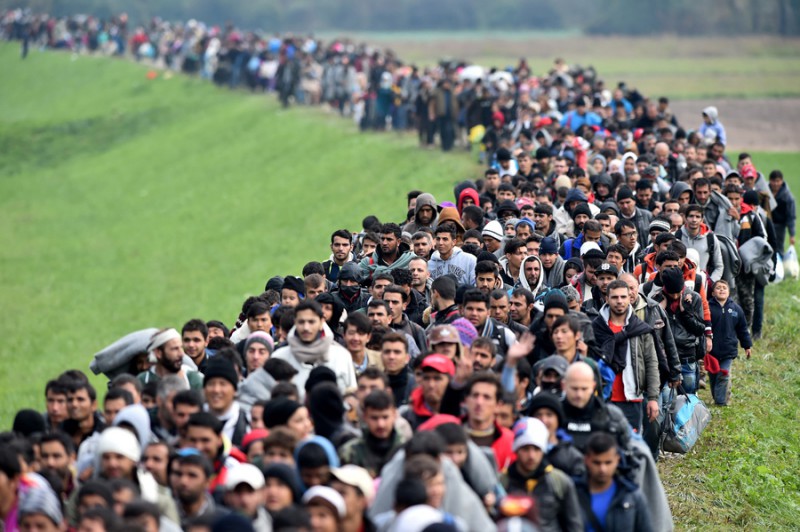
George Santayana, a Spanish-American philosopher—an expat who spent the last half of his life in Rome—first recorded the immortal words: “those who cannot remember the past are condemned to repeat it,” and never in recent history has his apt proclamation/ condemnation of the human race seem more relevant than it does today.

As Americans, we may ask, what is our past?  And it is a relatively simple answer, one taught in our classrooms and reflected in our mirrors and heard in a thousand different languages being passed down from generation to generation: America is a Nation of Immigrants.  Think of the American Story, the Puritans that fled Europe seeking freedom—religious freedom—whose blood, sweat, tears, rough living conditions, and economic opportunities laid the foundation of America while beginning what would eventually become the largest systematic genocide in history: today only about 5.4 million US citizens are American Indians or Alaska Natives, less than 2% of the total population.  But I digress… As the new Americans freed themselves from their evil Monarchic British Empire roots a west coast was at the same time settled by Iberian Conquistadors, a few of whom were Conversos (Jews) fleeing the Spanish Inquisition, most of whom sought fame and fortune and a new world.  As time went on more and more immigrants flocked to America, most of them seeking better economic opportunities, some desperately fleeing war, some escaping persecution, some seeking political asylum in the Land of the Free, but all hoping to find better lives and a new place to call home, and all of them largely unwelcomed by those immigrants who had gotten there first and were now the “real” Americans.  But we ALL come from immigrants, and are usually proud of the fact, endlessly figuring out and reciting what percentage of our heritage comes from what Country, telling and retelling family stories of when so-and-so went through Ellis Island or Angel Island or crossed the country on the Oregon Trail.  Americans are what we have always been: a nation of immigrants.

“Those Who Cannot Remember The Past…”
I was deep in the middle of remembering an especially cherished piece of my own past history when the sudden realization that “History Endlessly Repeats Itself” hit me—if not for the first time—than for the first time at 38,000 feet.  Since beginning this amazing journey to Rome for the USF AGI Program, the plight of the refugees waiting to be recognized as our brothers and sisters has been constantly on my mind, proving difficult if not impossible to put aside.  As I am sure is typical of such an overwhelming, powerful, positive experience, I am still both trying to readjust to “normal” life and constantly thinking about what I’ve just learned and heard and seen and what connections continue from there.  My flight home was uncomfortable in many ways, physically, emotionally, and not even endless free Bond movies could calm my thoughts.  So I gave myself a treat: permission to finally read The Boys in the Boat, Daniel James Brown’s bestselling account of how the University of Washington’s Men’s Varsity eight-oared Rowing team defeated Nazi Germany’s crew in the 1936 Berlin Olympics.  I was somewhere between the Polar Circle and the US/Canadian Border and I was mesmerized: after all, I am [as we say] a recovering coxswain, and was elatedly reliving those two years of early morning wakeups, freezing mist on the water, workouts and races with my own boys in our boat, and the various highs and lows of my time as the 2nd coxswain and only woman (but not Californian) on Pennsylvania’s Men’s Crew.  Also as an American, a History Major, and a Jew, I obviously love any story that has to do with beating Hitler and the Nazis.  Either way, I was completely engrossed when the following excerpt snapped back my Rome AGI experience to the forefront of my mind once again:

“On April 14, [1935] the day after the Pacific Coast Regatta on the Oakland Estuary, the dust storms of the past several years were suddenly eclipsed by a single catastrophe that is still remembered in the Plains states as Black Sunday.  In only a few hours’ time, cold, dry winds howling out of the north scoured from dry fields more than two times the amount of soil that had been excavated from the Panama Canal and lifted it eight thousand feet into the sky.  Across much of five states, late afternoon sunlight gave way to utter darkness… The next day, Kansas City AP bureau chief Ed Stanley inserted the phrase “the dust bowl” into a wire service account of the devastation, and a new term entered the American lexicon.  Over the next few months, as the extent of the devastation settled in, the trickle of ragged refugees that [one] had witnessed heading west the previous summer became a torrent.  Within a few years, two and a half million Americans would pull up stakes and head west into an uncertain future—rootless, dispossessed, bereft of the simple comfort and dignity of having a place to call home.”[i]

It sounded cruelly and ironically familiar.  Our forefathers left their homelands for myriad reasons, economic opportunity being by far the most popular, but all for what we would now argue were good reasons.  And here I was, reading about how 2.5 million of them migrated again, becoming Internally Displaced Persons in the process.  The only differences between the migrants fleeing the Syrian Civil War—or indeed any and all people seeking asylum and refuse in the European Union or similar countries, be they from Central Africa, Central America, Iraq, Afghanistan, Palestine, Eritrea, Somalia, or elsewhere—and the “Average Americans” who witness their daily struggle for existence on the news from the safety, warmth, and comfort of their homes are a few generations, the usual cultural misunderstandings that arise (at first!) when new immigrants arrive, and some basic semantics.

Historians believe that when it comes to immigration in America a clear pattern exists, each wave of asylum seekers, economic migrants, and political refugees as unwelcome and hostilely treated as the last, each wave sparking an outburst of xenophobia and anti-Internationalism that is notably harmful to the greater American purpose and sadly so often fatal to those refugees America has, shamefully, turned away.  Are we doomed to repeat our history, or have we finally learned enough to recognize that the people on our televisions, phones, and computer screens are our brothers and sisters?  We must welcome them, usher them to safety, help them reach what friends, relatives, and countries they may already have ties to, and be with them as they are forced to reexamine and restart their lives.  Or shall we, a nation of immigrants, condemn ourselves to repeat this inhumane, unethical, cross-purpose knee-jerk anti-immigration merry-go-round?


[i] Brown, Daniel James. (2013). The Boys in the Boat: Nine Americans and their Epic Quest for Gold at the 1936 Berlin Olympics. The Penguin Group: New York, New York, USA.

Batwa Pygmies: Internally Displaced Persons and Grassroots Action


Batwa Pygmy women practice in Kellerman Foundation's economic development program. - Photo credit: Kellerman Foundation

In 2015, the number of refugees and forced migrants reached the highest number since WWII, with 59.5 million people forcibly displaced by conflicts around the world (UNHCR, World at War). Western media attention focuses on migrations to Western Europe, and people fleeing South and Central America to the United States. Many of these forced migrants meet the UNHCR definition of refugees. However, internally displaced persons (IDPs) need not be lost. The case of the Batwa Pygmies in Uganda is such a case, and one that unfortunately may increase as climate change displaces populations within and without their native countries.

Batwa Pygmies: A displaced population

The Echuya Batwa, commonly known as Batwa pygmies were originally a hunter-gatherer population considered to be original inhabitants of the Great Lakes region of Central Africa. They lost their land to agribusiness and conservation interests, becoming increasingly marginalized as they attempted to maintain their livelihood on the fringes of dominant society. They were not included, compensated, or given land as they were ejected from the forests in which they had lived as skilled hungers and gatheres. The establishment of the Bwindi and Mahinga national parks resulted in the government definitively evicting the Batwa. In the First periodical Report of Uganda to the African Commission on Human and People’s Rights (2006), it is asserted that “The Batwa in Uganda (today) experience systematic and pervasive discrimination from the government and other sectors of society, and their rights as indigenous peoples are neither recognized nor respected”. The Batwa Pygmies can be considered environmental refugees, and internally displaced persons. Largely landless, they are incredibly poor, with extremely limited resources to integrate into dominant society, and engage in low-wage manual labor, prostitution, begging, and other desperate means for survival.

The Kellerman Foundation History

In 2002, US Dr. Scott Kellerman traveled to Uganda on a mission to assess health access situation for Pygmies. What he found was “heartbreaking”; a displaced population living in terrible conditions, where 1/3 of their children died before their fifth birthday. This mission became his focus, and he began directly providing medical care to Batwa Pygmies.

I spoke with Dr. Kellerman in Grass Valley in January of 2016. When he is not in Africa, he works with a local community clinic, and he is a doctor stationed within an alcohol and drug treatment center. After their initial trip, Dr. Kellerman and his wife, Carol, immersed themselves in learning the language and developing relationships. Dr. Kellerman provided mobile medical clinics, hanging IVs from trees and seeing 200-300 patients daily. Through their fundraising efforts, their small clinic became the Bwindi Community Hospital, now one of the best hospitals in Uganda. In 2004, the Kellerman Foundation was established to sustain their efforts. Their work has grown with three primary areas of focus:

1) Healthcare: With the growing hospital at the epicenter, healthcare delivery includes outreach to schools, treating average of 2800 patients monthly; immunizing children; and providing insurance access.

2) Community Development: Community development initiatives include education, with 15 schools educating about 250 Batwa children; the Batwa Women’s Center and adult education which includes health education but also vocational training to make saleable goods; and agriculture, with gardens and animal husbandry for income sources.

3) Nursing Education: Uganda Nursing School Bwindi opened in 2013 as the only advanced-level program in a rural region of one million people.

Collaborating for Impact

The Kellerman Foundation represents a truly successful grassroots effort. As I was learning about the Kellerman Foundation, I was also researching Medicins Sans Frontieres (MSN) and considering the similarities, differences, and opportunities for synergy. Knowing as we do that the future brings increased issues for environmental refugees (especially considering climate change) we might consider how these systems can complement each other. Dr. Kellerman talked about partnering with MSN; MSN will base at Kellerman’s hospital to serve populations fleeing frequent conflict in the region, mobilizing major support in times of crisis. MSN is now a huge, multinational NGO with a budget over $600 million, with a broad mission to provide medical support where it is needed most. Kellerman’s relatively small operation is dedicated long-term to a population. Both aim to address root cases: Kellerman through economic development, MSN often focusing on bringing atrocities to light. Dr. Kellerman also works with local government, who agreed to provide safety for the clinic, and the Anglican Diocese of Kinkiizi. Kellerman Foundation spreads gospel; MSN is not affiliated with any religion. We can look to this partnership not only as an example of the diversity in nonprofits, the benefits of small, grassroots efforts as well a major operations, and as well look for models of collaboration in the third sector that can work to address the major humanitarian issues we face with refugees and internally displaced persons.

Nosce Te Ipsum: A Story of Roses, Restaurants, and Artichokes

Photo Credit: http://www.bing.com/images/search

Prepared by: Virginia Turner

Please indulge me as I share what may appear on the surface to be an unimportant encounter that I experienced on my last night in Rome, Italy. I feel that I shall be reflecting on this encounter for some time as there are many lessons contained within it. However, as we have certain deadlines, I shall do my best to capture some of my thoughts here now.

It was late evening and I had left the warmth of my AIRBNB hotel in search of the perfect Italian restaurant and had visions of some wonderful soup and perhaps that classic side dish – the Roman Artichoke – which had recently been introduced to me by my Professor as “one of the classic dishes” of the region. Finally I settled upon a small Italian restaurant on a side street and I ordered the soup and artichoke side dish. The evening passed relatively uneventfully but, as I was about midway through my meal, a man entered the restaurant with red roses in hand attempting to sell the roses to the clientele, but without much success. The restaurant staff ignored him but neither did they obstruct him from passing through the restaurant. When he came to my table I initially greeted him in Italian “Buono Sera” and he responded in kind. Quickly reaching the extent of my Italian, and noting he did not look Italian, I switched to English and asked him where he was from and he responded “I am from Bangladesh, I am Bangladeshi.” It did not take much prompting for him to tell me about how life was so hard for him in India and how he felt he had to come to Italy ‘for a better life.’

As I continued to listen attentively to this man, it was as if a mask had fallen away from his face, his eyes became lively and he smiled at times. He asked where I was from and I told him “from U.S., California, close to San Francisco” and he asked about what that was like to live there. We talked of the weather and he appeared very happy that any person would care to listen to him. At one point he tried to give me all his roses. “No, thank you, you should sell them” and then, “Here let me buy one, how much?” The man was ecstatic at this point and thanked me profusely as we said our good-byes. During our entire encounter, the restaurant staff and all customers had ignored us as if we were both invisible.

I paid my bill and made my way back to the hotel; the encounter with the man played back in my head. Something had happened to me that seemed quite natural but felt quite different to me for I had given my complete and full attention to a stranger. And somehow that stranger recognized that I really wanted to hear their story and to understand how they came to be where they are at this moment in their life. That stranger understood “true listening” was in progress and they decided to open up their life experience to me and to trust me with that which was a sacred trust. This is what I believe Pope Francis, as the first Jesuit Pope, was talking about when he mentions the “stories of precious value’ that all refugees have to tell. And this is perhaps what the Jesuits mean by ‘listening’ as part of their values surrounding accompaniment and a way of being with those that they serve, or as one portion of the JRS website put it “Being with refugees and asylum seekers, including detainees, you learn the importance of listening, an attentive non-judgmental listening, which conveys that the person and his story matter.”

I had been given a glimpse of this ‘selfless listening’ in a few moments with a stranger in a small Italian Restaurant and am still reflecting on what this may mean for me going forward on my journey.

Then I reflected upon how I would “normally” claim that I was listening to those around me. I would proclaim that I had been listening to someone, but, in reality I was most likely busy anticipating what the other person would say next, and perhaps even crafting my response to what they were saying. Of course this makes true listening impossible. And I have been both the victim and perpetrator of the worst scenario, that is, the person who interrupted the speaker, or who was interrupted before I had finished speaking. This is not the correct way of listening or communicating with others, for just as the stranger in the restaurant can sense that you are attentive (or not) to their message, any speaker can sense whether you are truly “hearing” what they have to say.

In the past I had taken classes in communication stressing the importance of accurate communication in the context of the business world. (Haven’t we all taken these classes?) These communication courses are part of every business school curriculum and accuracy is often emphasized. What is missing are the important Jesuit themes of mutual respect and sincerity when communicating with those around us. Too often these important cornerstones of communication are brushed aside or, worse, not mentioned at all in traditional business school courses. Generally one takes the test to pass the so-called “Business Communications Class” and moves on to the next class without incorporating any improvements in our communications with others, business or personal. This is the non-Jesuit style of teaching students.

My encounter was a pivotal moment for it touched my life in a very real way and how that experience was available to me only after my year and half of Jesuit education at University of San Francisco and, more specifically, after I had completed the AGI / Rome program. And it is only through my reflections after the encounter which I attempt to describe that I am cognizant of a huge difference between what I know call ‘surface listening’ versus ‘selfless listening.’ The latter is important not merely out of respect for others, but because this latter type of listening can make such a positive difference to both listener and speaker. I feel I am now attempting to cross the bridge from reflection to action but that this step has not been defined as of this writing and hope to outreach with others on this important step as I continue to reflect on my AGI / Rome experience.

For more see: http://en.jrs.net/news_detail?TN=NEWS-20160118055435
For more see: http://en.jrs.net/Assignment_Detail?TN=DTN-20140923082537
For more see: http://sjweb.info/documents/education/pedagogy_en.pdf
For more see: http://en.jrs.net/Publications_List?ID=10

Friday, January 22, 2016

Finding Value: The Importance of Integration for Migrants, Refugees, and Everyone Else


Intentional welcoming of refugees, with an effective process to support integration, must be a priority to support positive outcomes for refugees and host countries alike. Opening borders and providing the right to work are key, but according to many, these must be part of a more inclusive path to integration. This imperative was affirmed by multiple speakers in January 2016, who presented to USF Graduate School of Management students on issues related to refugees, forced migration, and human trafficking. Ciara Peri, Project Director at Centro Astalli, a Jesuit Refugee Services organization providing refugee services in Rome, Italy, emphasized the importance of dignity and pathways to self-sufficiency, as did Ana Clara de Martino of Caritas, the other primary refugee services in Rome. Laura Cantarini of UNHCR’s Rome office, further underscored the necessity of providing a ladder, as did Director, Fiorella Rathaus of the Consiglio Italiano per Rifugiati (CIR). Rathaus emphasized the urgency of integration: “If we don’t start from day one, recognition process takes long time and people become marginalized from the beginning and no effort is enough to reintegrate. From economical point of view, that has to be taken into consideration”. She went on to say that although difficult to measure, if refugees enter black market, become marginalized, “We are all lost. The consequences are extremely serious ones.” Certainly we see such marginalization in the U.S. not only with recent immigrants, but with others, including certain African-American, Latino, and native American communities, and the uneducated poor.

These paths to self-sufficiency may vary in emphasis based on the specific needs or cultural differences in migrant and host populations, but primary elements are fairly universal. Just providing housing and food will not suffice; ways for people to engage positively in the community, to create value and be seen, are needed. Generally agreed upon strategies include provision of language classes, healthcare, legal services, cultural orientation, and basic needs initially (housing, transportation, basic supplies). More specialized examples might include focus on gender roles, such as classes that have begun to be offered in Norway, now being replicated following the Cologne incident.

As best practices for supporting refugees and migrants are developed and implemented, as nonprofit leaders we should simultaneously consider how we can learn from and contribute to successful refugee integration policies with existing marginalized populations in the US. For example, agencies are increasingly recognizing the mental health needs of migrants, and although mental health services are offered by some, based on the immense trauma experienced by an overhwhelming number of refugees (by definition) increasing trauma-focused mental health interventions should be explored further. Trauma-focused treatment is a growing field in the US found to be successful in promoting pro-social behaviors. Trauma-focused programs have been increasingly offered to people with chronic substance use disorders, youth involved in the foster care system, and people involved in the criminal justice system. Promising findings have been found with refugees as well (Lambert, 2014).

In delivering services, we must consider how are we creating pathways to dignity and self-sufficiency? How are our systems, from top down and bottom up, from how we treat individuals to how we set strategy, built to support people to move toward self-actualization, to realize their dreams, to have a place of value in commumity and society.

We return to the idea of listening to people; of understanding and honoring the particular experience and unique aspirations of individuals. A partnership, or as Jesuit Refugee Services define its, accompaniment, is an approach that recognizes shared humanity in an equal way, so that together we can realize self-actualization and promote safe and strong societies.

Bringing it Home: Personal Responsibility and Social Justice


Photo from the National Museum of Italian Emigration, Rome, Italy
“An ethically centered and balanced approach to human migration needs an analysis of hospitality as a societal responsibility and a human right. It requires understanding the core of a hospitality ethos centered on the notion of human dignity and social justice”. Marco Tavanti
During a week-long academic global immersion (AGI) program, students of the University of San Francisco’s School of Management, specially graduate students of public and nonprofit administration, studied issues related to refugees, human trafficking, and forced migration. This issue may be more urgent than ever. According to the Office of the United Nations High Commissioner for Refugees (UNHCR), worldwide displacement was at the highest level ever recorded. In their 2014 Annual Global Trends Report: World at War, it is reported that the number of people forcibly displaced at the end of 2014 rose to 59.5 million compared to 51.2 million a year earlier and 37.5 million a decade ago. "We are witnessing a paradigm change, an unchecked slide into an era in which the scale of global forced displacement as well as the response required is now clearly dwarfing anything seen before," said UN High Commissioner for Refugees António Guterres.

Half of the world’s refugees are children. And nearly 90% of refugees are from countries considered economically less developed.

The issue was real and present in Rome, Italy, the site of the program, with Italy having accepted more refugees than ever in 2015 and leading advocacy to allow refugees to relocate within the EU. Humanitarian aid organizations like UNCHR, Caritas, and Jesuit Refugee Services spoke with students. Many students asked, “What can we do?” Basic actions were discussed:

1) Donate

2) Advocate, help to spread awareness (the imperative and urgency of the crisis) and dispel myths ( such as myths that refugees are manipulating systems, threatening economy, and driving crime)

3) Volunteer to provide technical assistance an organization, such as JRS, improve strategic planning or evaluation.

What also can emerge, though, is a bigger idea about the global systems of oppression and inequality that promote refugees, human trafficking and forced migration. As individuals and as nonprofit or public sector leaders, we can examine our participation and responsibility in these systems.

Examining our personal lives, we should be aware of the daily choices we make, the services we use, the origin of goods that we purchase. The biggest driver of forced migration is conflict. New conflicts are emerging with old conflicts unresolved. How are we creating, affirming, and promoting politics of peace? Imminent, and in fact underway, will be people forcibly displaced due to climate change. What choices, what political focus, can we use to mitigate this crisis?

Who are “refugees” in our local communities, who are the marginalized? Are they youth fleeing poverty and family violence? Are they people with mental illness or chronic substance use disorder seeking a place in the community? How are they afforded opportunities for upward mobility, for finding places of value in community, and how are they treated with dignity?

We can challenge ourselves to examine how we are incorporating the “ethos of hospitality” into only our daily interactions. But also, as leaders in nonprofit and public administration, honestly assess the systems that we can influence, and become proactive in addressing the circumstances of marginalization that create displacement and refugees in our own communities and around the world.

Thursday, January 21, 2016

What AGI-Rome Has Meant for Me


During the week in which I had studied abroad for AGI-Rome I had the unique opportunity to have received a first-hand understanding of various fields within human trafficking and refugees. I have learned many life lessons during this week that I will apply to both my professional and personal life. Of those there are three main points that have impacted me the most in my professional career growth. First is the understanding the necessity for NGO’s to work together while maintaining their own short and long-term goals. Second is understanding how “accompaniment” is utilized by many agencies to help with service delivery. Third is receiving a better understanding of the different types of refugee classifications and how the different classifications require different services of help.


Prior to coming to Rome when I thought about the refugee crisis happening in Europe I would read news articles about the hundreds of thousands of people in refugee camps that are in in unimaginable living conditions and the hundreds of people that were dying at sea trying to flee their native country. I had this overwhelming feeling that the whole refugee crisis was being mismanaged. After spending a week in Rome and meeting with local NGOs I have quite a different view of the crisis. It appears there has been some quick decisions made by the government that has had some adverse effects. However there are many agencies that are working diligently within themselves and with other agencies on developing short and long-term goals to help with the crisis.


According to
Merriam-Webster  dictionary, accompaniment is “to happen or occur at the same time as or along with (something)”. Some of the agencies we meet embrace this idea of accompaniment at every level of interaction with refugees by working side by side with refugees to provide the help they need. For example, we meet with two agencies, Centro Astalli and Centro Ascolto Caritas, that have opened centers to provide services directly to the refugees; such as medical, legal, education, housing, showers, meals and laundry. Other agencies we meet with that are helping refugees are JRS International, UNHCR and IDLO.


It is becoming more and more difficultly for agencies to provide the necessary services to refugees due to of many factors. One of those factors is the addition of new laws and the changing of existing laws around the different classifications of a refugee. For me learning and understanding the difference between an immigrant, migrant, refugee, asylum seeker and internally displaced person (IDP) has helped to understand the difficulty in service delivery. The agencies know that as an individual entity they cannot provide all the necessary services. In order to provide the most efficient services it is necessary for multiple agencies to work together.


During our short time in Rome we had the opportunity to meet and talk with a refugee. He shared with us his incredible story of why he had to flee Kenya to seek asylum in Rome. His story put into perspective the difficulties refugees face and to show how important it is to have agencies like Centro Astalli and Centro Ascolto Caritas to provide direct services to refugees to.

The 2016 Academic Global Immersion Program in Rome

AGI-Rome '16 meeting with Jesuit Refugee Service - Centro Astalli

The Master of Nonprofit Administration (MNA) and Master of Public Administration (MPA) students  who participated in the 2016 Rome Academic Global Immersion (AGI-Rome) learned a great deal about the current EU refugee crisis. Speaking with Chiara Peri, of the Jesuit Refugee Service (JRS-Italy) Centro Astalli Foundation, students learned that this is an issue of social inclusion and appropriate management. Jesuit Refugee Service is one of the few organization who work in Syria and know the struggles of people who have lost hope for their future and seek new opportunities in Europe. In Italy, the refugees welcomed and assisted by Centro Astalli - the first place visited by Pope Francis after his election - are primarily coming from North African struggling countries and other contexts of conflict and extreme poverty. Refugees who come to the coast of Italy are asylum seekers who escape very difficult situations and seek better opportunities for their families and children. We learned that there are more than 30% of refugees who are victims of torture and are affected by PTSD. We learned that situations of refugees - protected by international law - are mixed with illegal smuggling of migrants, mostly economic migrants, as well as criminal activities due to human trafficking. Student learned about the managerial and policy issues connected to forced migration in Europe and for nongovernmental organizations (NGOs). 


AGI-Rome '16 participants excited about their tickets for an audience with Pope Francis
The AGI-Rome participants were excited to meet Pope Francis during the General Audience on Wednesday January 13, 2016. Some even were personally blessed by him afterwards. Most of our students are not Catholic and some not believers, yet the inspiring public figure of Pope Francis is inspiring for all of us. After announcing the presence of students and faculty from Jesuit University of San Francisco, Pope Francis offered some biblical reflections on God's mercy. What can be seen as a Biblical reflection to faithfuls, the words of Pope Francis - who has been an advocate for refugee acceptance, human responsibility, and compassion for the poor - takes on a whole new meaning for us at a Jesuit university whose values are for the promotion of social justice and educating men and women for others. Hospitality to strangers becomes a moral call and a responsibility to institutions, congregations, families and individuals. 

AGI-Rome '16 students meeting with the United Nations Refugee Agency (UNHCR)

The AGI-Rome '16 participants met with the United Nations Refugee Agency (UNHCR). Laura Cantarini, representing the work UNHCR-Italy, illustrated how a properly managed refugee protection program could be a solution to human security and societal integration. The UNHCR has the primary mandate to protect 33.9 million uprooted or stateless people. With the Syria and other ongoing conflicts around the world, there are more than 60 million of vulnerable people in need of protection. These include internally displaced people (IDPs), refugees, asylum seekers, stateless people, and many of them are children, women and girls. Laura Cantarini explained to us the situation and the dedicated work conducted by the UN agency in Europe. There has been a sharp increase of persons forced to flee: + 8 mil in last ten years (59, 5 million refugees in 2014 as opposed to 37, 5 in 2004). Since 2011 there has been a devastating war in Syria and this is in addition to 15 new conflicts in the last 5 years (e.g. Nigeria, Yemen, Ukraine). In 2014 there has been 42,500 new refugees/day - four times more than only four years before. Voluntary repatriation is also very small with only 126,800 in 2014. Yet, the UNHCR is assisting the EU in a promising program of relocation of refugees from Italy and Greece to Northern European countries.  As an Italian citizen, Laura also proudly noted that the Italian Marina Militare has rescued stranded vessels in the Mediterranean Sea during the operation Mare Nostrum saving more than 150,000 people in just one year. 


Wednesday, January 20, 2016

America- The Land of the Free or Fearful?

By Colette Whitney

Before the AGI program I took some time to explore Barcelona, Spain. During my stay in Spain I stayed at a hostel and was accompanied by people from all around the world including Australia, Brazil, Scotland, Germany, Canada, Israel, England, Argentina and Egypt.  When I explained to them that the purpose of my travel was to end up in Rome to take a class on the refugee crisis and forced migration, I got multiple forms of praise and intriguing questions about what I will be learning and doing. It was able to observe how every person had something to say about the issue, the majority wanting to know how they can help or how their countries have been helping. Not one person I talked to sounded afraid or intimidated by the topic.
It is interesting to be in a area that accepts refugees with open arms. Italy currently has almost 94,000 refugees right behind Germany who is hosting over 250,000. Then there is America, that is hosting over 267,000. Interesting, America is hosting almost the same amount of refugees as Germany, and America is 20x larger. Shouldn’t America’s refugee numbers outshine Germany’s? Why is it that America, one of the most powerful and influential countries is having such a pushback from this global issue?

If you have been watching the news or have been engaged in social media in the past couple of months, you will see that there has been outrageous government debates for accepting and not accepting  more refugees into the US. But why? Most people will respond with a  fear of a potential  terrorist attack, like what happened in Paris on November 13th 2015. These refugees are coming from corrupt countries and are therefore violent, right? The idea that these people are escaping their countries to leave the violence behind and start a new life completely goes out the window. A chart from the State Department, Migration and Policy Institute shows that since 911 America has taken in 784,395 refugees and only 3 have been arrested on terrorism charges. Eighty percent of the terrorist attacks since 911 have been from US citizens. So where is the real threat? Why is America so stuck in fear?

The problem with today’s society in America is that people will hear one bad story and it stays with them. The negative stories and facts tend to be the ones that most people talk about and share, especially when they are ignorant not educated on the topic at hand. So how do we change this? How do we educate more people on what is going on in the world and help make a positive impact? The more people understand the real issue of forced migration, the better chances we have on improving it. Here are a few ideas to start out with:
1.    Don’t believe everything you see and read on social media/facebook
2.    Read credible resources and stay away from Fox News
3.    Talk to others and spread/share information and ideas
4.    Learn about other world views

This is what we, the AGI program will discuss throughout the week a the AGI program. Stay tuned.

“For the work we have done, they should be thanking us”.


Prepared by: Harneet Kaur

"For the work we have done, the only thing we deserve for the EU is a thank you, not them suing us". The tittle quote comes from the Interior Minister Angelino Alfano that is speaking in regards to the away suing Italy for not being more productive on finger printing at the shores of Italy. Marco Marcone, the head of immigration departments at Italy's Interior Ministry says that since January 2915 they have identified 80% of Asylum seekers. They have saved over 200,000 migrants from the sea recently. "We have done a lot for this. We are very proud. For all this we deserve a thank you from the EU".

He further explains that over 4,600 people were rescued off the coast of Libya this past weekend. The weather has been deteriorating and the smugglers have become more cynical and that has caused thousands to die in ship wrecks alone this year. Many migrants refused to be finger printed and of those refusing often tend to be Syrians and Eritreans. We try our best to educate these individuals but they often do not plan on staying in this country long.

This information was extremely relevant for me as it tied our week together in my perspective. We learned all this information from the very informative speakers but as I read thorough these articles I often find the same common theme. Many Italians are upset with EU for not doing more to help relieve their burdens. Moreover, this ties into the conversation we had as a class at Su Ghetto. The difference these small and large organizations make is large scale and extremely significant. The point is that they are doing something and actually making progress with the marginalized communities that are having to leave their homes and lives for various reasons. It is a matter of appreciating what they are doing. Moreover, after the UNCHR presentation I was able to firmly believe that the EU is doing something to help. Even if it may be small scale for the time being but the relocation project will help hundreds of families reunite and help relieve Greece and Italy of the large burden they have been placed with. The work that is being done to help these individuals is remarkable.

References

http://www.thelocal.it/20151209/italy-slams-eu-over-refugee-crisis-criticism

In Rome, migrant children forced to turn to prostitution!


Prepared by Harneet Kaur

"The illegal stuff, it is the only option I have". CNN reports interview a young Egyptian migrant at the Roma Termini and he tells them that his parents have spent thousands to get him here and he has to find a way to pay them back. This is the case for hundreds of migrant children arriving at the Roma Termini. However, this report specifically targets the concept of migrant children having to result to prostitution and selling illegal narcotics.

Emanuele Fattori, the chief of Police at the Roma Termini has seen it all. However, what surprises him is that the children under 14 have increasingly become the main targets. The reason for this is because under Italian law a child under 14 cannot be taken to trail in this country. Consequently, the pimps and gangs of the city have been preying on children under 14.

The report found that there has been a spike in children arriving unaccompanied at the station. They left their countries hoping to get away from the troubles of home but prostitution was never what they expected. The report follows a group of Egyptian boys that have been forced to sell themselves by their Italian pimps. One of the boys out of that group was willing to speak with the reporter and explain to her that his parents sold everything to get him here. Once he arrived at the terminal his friend and him were very hungry. An Italians man offered to feed them if they were willing to help him sell the "illegal stuff". He said it first began as selling drugs but he never thought it would lead him here.

Zander, works for a center dedicated to helping refugee minors. He helps translate and support the Egyptian migrant children around him. He tells the reporter that the families back home do not ask where the money came from. They just expect that they send money back home to help.

This scenario can be true for the migrants arriving in the United States as well. Especially, for the children just like the unnamed Egyptian boy. It is hard to see these children suffer this way at such a young age. This is where the misconception of refugees needs to be changed. These children do not leave their comfortable lives and loving families to sell their bodies in another country. That is far removed from the concept of a better life that the immigrants in my family had in mind when they traveled to the United States. This recent wave of displaced persons is only leaving because they simply are no longer safe in their home countries.

The organizations in this city are doing a tremendous job helping these individuals get situated with their lives. They are very popular as word of mouth seems to be their only out reach. However, if posters or small printings in the common refuge languages were placed around the termini about the centers, these children may not be so easily coerced by the pimps. These posters will help the children and the centers in my opinion and it's a small manageable step towards the right direction.

References
http://edition.cnn.com/videos/world/2015/06/17/pkg-elbagir-migrants-rome-amanpour.cnn/video/playlists/nima-elbagir-migrants/

Monday, January 18, 2016

Food Security and the Refugee Crisis

Photo courtesy of Wikipedia

By Virginia Turner

I would like to briefly address food security and the refugee crisis. Along the topic of collaborations with IGO’s, The United Nations World Food Programme, (UNWFP, or WFP) is a major Intergovernmental Organization, (IGO), which frequently partners with multiple organizations to address the food and nutrition needs of vulnerable people including refugees. To be clear the UNWFP is an IGO and not a nongovernmental organization. The NGO label came about as a way of distinguishing NGO’s from IGO’s( such as the United Nations) since a main distinction for NGO’s is that they are nongovernmental and also nonprofits.

WFP was selected due to my enduring interest in food delivery systems and nutrition assessment in connection with vulnerable people. WFP is the primary United Nations IGO dealing with food, thus, no surprise that they align themselves with the U.N. Zero Hunger Challenge (a.k.a.Strategic Goal #2). I would be remiss if I did not mention that with even the limited research that I was able to accomplish concerning WFP, the words of our recent esteemed speaker, Ms. Laura Cantarini, (UNHCR lecture dated 1/15/16, Hotel Atlantico, Rome, Italy), are with me now as I feel I have gained a more nuanced appreciation of the extremely complex issues and challenges, both at a grassroots level and at the higher policy levels, vis-à-vis ‘humanitarian aid work’ at the NGO or IGO international levels. I realize that my initial assumptions surrounding “food delivery systems for refugees” were naïve and unrealistic. We are not talking about planes dropping food, or trucks being driven exactly where they wish to go with no problems. Rather, it is a complex and intricate food assessment and delivery system with numerous and layered variables. Plus, to add to the challenge – on an international playing field - any variable may change and completely change impact or outcomes.
People on the Move: There will always be refugees as long as there is conflict, persecution of others, and great disparities in access to opportunities and wealth in this world. People will find ways to move to geographical areas where they discern there could be a better life for themselves and their families and, in the case of asylum where they feel safe. Who among us would not?  The more recent influx of refugees has placed incredible strains on the economies of host countries, and of course the infrastructures on food provision IGO’s such as UNWFP, is part of that stressed system, part of that equation. And yes, we can access UNWFP’s website and read about their food programs for it is necessary that we know these models. I propose that more may be learned from the failure of current models, especially when the current systems are stretched beyond their capacity as is currently happening, according to UNWFP and other sources such as FAO, 2015. Learn more:
Funding shortfalls: Reduced food provisions for the Syrian refugees are quite serious according to recent news stories and the service providers themselves.  Witness recent articles, (McLaughlin, Daniel, 2016), published in The Irish Times noting serious funding issues for WFP.:
 “At the end of 2014 the World Food Program announced that a crippling funding shortage had forced it to halt provision of food vouchers to Syrian refugees in several Middle Eastern states. The United Nations organization warned that the move would “endanger the health and safety of these refugees and [potentially] cause further tensions, instability and insecurity in the neighboring host countries. So it proved, and cutbacks to the World Food Program and other aid organizations continued last year, depriving hundreds of thousands of refugees of assistance in poor host countries where they have few, if any, opportunities to find work.”

Funding Strategies: According to their website, the WFP relies on voluntary contributions to finance its humanitarian and development projects. Since WFP has no independent source of funds, all donations either in cash or in-kind must be accompanied by the cash needed to move, manage and monitor WFP food assistance. WFP's funding comes from Governments, Corporations, and Individuals and is on an entirely voluntary basis according to their website.  Governments are WFP’s principle source of funding and they note that they “receive no dues or portions of the UN assessed contributions.”  They assert that the WFP receives government support from “over 60 governments.” The WFP also discusses a ‘corporate-giving program’ but this program is not described in any serious detail at least not on their website.
Bigger Picture: Even if one is not an International Humanitarian Aid staff person we know and understand the importance of longer term strategies such as improving conditions in the country of residence whenever possible.  Yet we have also learned, as in the case of conflict (war), there are so many factors which are out of the hands of the service providers.  Remember these are service providers who are (supposedly) adhering to ethical codes of neutrality and impartiality not only for their own protections, but to gain access to those needing the services and to protect their lives. In this context, we see the ‘reacting to emergencies’ assistance paradigm played out over and over. The recent vulnerability of providing food (and other resources) to refugees has been described as a donor weakness by UNWFP (certain Country donors did not come through), however, this response appears superficial and actually leaves, in my view, numerous unanswered questions. Indeed, if I were the donor representative for a Country I might as for more details as would other stakeholders (partners?). In my view, the UNWFP should implement an evaluation of what happened vis-à-vis the recent food shortages and be as transparent as possible to all stakeholders, and further, provide future strategies to address funding shortfalls which negatively impact food delivery systems.
In referencing IGO’s and food delivery systems related to refugees in particular, we need to be mindful that refugees are restricted in their physical movements for a variety of reasons such as their documentation and Country of Origin status. This week we learned that, in the majority of cases, refugees have fled their Country of origin with minimal documentation or material items, thus, upon arrival to a host Country, they have very few resources. Obviously refugees are vulnerable to those wishing to exploit their desperate circumstances. The take away here is that food delivery systems can never reach 100% (too many variables) but it can and should be improved. I do agree with the Jesuit Refugee Services’ recommendation of calling for other funding sources and models to be explored to ameliorate the numerous vulnerabilities in the food chain systems, or the direct quote from JRS:
“Reforms should be sought in the present system of funding food needs, so that the ongoing needs of refugees and other vulnerable populations are not neglected due to competing demands from new food emergencies.”
In closing, merely studying food security challenges surrounding refugees and UNWFP has opened my eyes not only to the many complexities surrounding this topic, but to the myriad of things that I take for granted in my life such as clean water, nutritious food, and a home where I feel safe and secure.  My assumptions about my life were further emphasized when listening to the story of “Jerry” (not his real name) the refugee who spoke to us about how he became a refugee and eventually obtained asylum in Italy.  But “Jerry” is separated from his family and still feels that he cannot return to his Country safely. As I am reminded about my privilege in this global world, I know that as I continue my studies concerning NGO’s, IGO’s and other entities in the nonprofit sector I will build upon all that I have learned in the AGI-Rome program whether addressing food security issues or other challenges.